

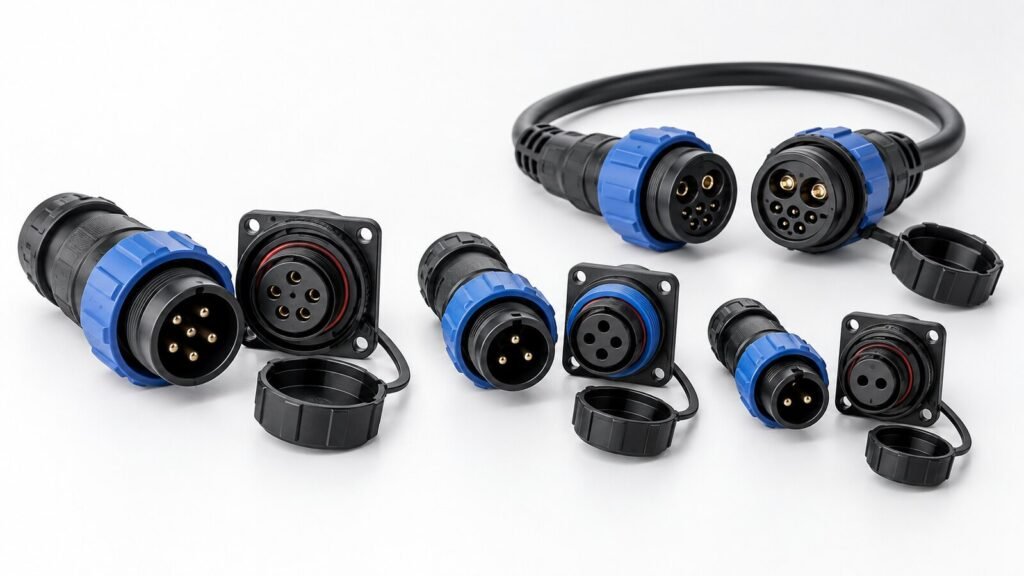
Waterproof connectors are widely used in industrial automation, outdoor lighting, energy storage, electric vehicles and equipment exposed to moisture, dust or vibration. Selecting the correct connector helps prevent unstable signals, overheating, water ingress and premature equipment failure.
1. Determine the Required Waterproof Rating
The IP rating indicates how effectively a connector protects against dust and water. IP67 connectors are protected against dust and temporary water immersion, while IP68 connectors are designed for more demanding water exposure under specified test conditions.
IP67 is commonly suitable for outdoor lighting, industrial machinery and electric vehicles. Equipment exposed to frequent washing, continuous moisture or deeper immersion may require IP68 protection. The complete connection—including plug, socket, cable and sealing components—must meet the required protection level.
2. Confirm the Rated Current and Voltage
The connector must safely support the electrical load of the equipment. Signal connectors may carry only a few amps, while battery, motor and energy-storage applications can require 20A, 50A, 120A or more.
- Rated current and voltage
- Cable conductor size
- Contact resistance
- Temperature rise
- Required safety margin
Do not select a connector only by its maximum rating. Ambient temperature, cable size and installation conditions also affect long-term performance.
3. Select the Correct Contact Configuration
Common configurations include 2-pin connectors for basic power, 3-pin connectors for live, neutral and ground, and 4-pin or 5-pin connectors for sensors and automation. Eight-pin models are often used for signal or Ethernet applications.
Hybrid configurations such as 2+4, 2+6 and 2+1+5 combine high-current power contacts with smaller signal contacts. They are especially useful in electric motorcycles, battery swapping cabinets, robots and energy-storage systems.
4. Compare Locking Structures
Threaded Locking
Threaded connectors provide a secure, vibration-resistant connection for sensors, machinery and outdoor equipment.
Self-Locking
Push-pull or self-locking designs provide faster mating and disconnection, making them suitable for equipment that requires frequent installation or maintenance.
Panel-Mount Options
Panel sockets are available with round, square or diamond flanges. The correct design depends on enclosure thickness, mounting-hole dimensions and available installation space.
5. Consider the Operating Environment
Evaluate operating temperature, UV exposure, humidity, dust, oil, vibration, mating cycles, chemical exposure and cable bending requirements. Flame-retardant PA66 housings, silver-plated copper contacts and durable seals can improve electrical and mechanical reliability in demanding environments.
6. Choose the Right Cable Assembly
A waterproof connector alone does not guarantee that the complete assembly is suitable. Confirm conductor size, cable length, jacket material, flexibility, shielding, bending radius and indoor or outdoor use.
Custom assemblies may include straight or right-angle connectors, T-shaped or Y-shaped splitters, molded cables, panel sockets, RJ45, USB or customer-specified terminals.
7. Verify Certifications and Quality Control
Depending on the market and application, buyers may require UL, CE, TÜV, CQC, CCC or RoHS documentation. Electrical, waterproof, insulation, temperature-rise and appearance inspections should be completed before shipment. For customized projects, approve samples and drawings before mass production.
Why Work With CONNIXTECH?
CONNIXTECH supplies waterproof connectors and customized cable assemblies for industrial and e-mobility applications. Our capabilities include M-series connectors, high-current battery connectors, power-and-signal hybrid designs, custom cable lengths and terminals, in-house tooling, injection molding and OEM/ODM development.
With more than 14 years of manufacturing experience, a 12,000㎡ production facility and over 20 R&D engineers, we support customers from connector selection and drawing confirmation to prototyping and mass production.
Conclusion
Choosing the right waterproof connector requires more than matching the connector size. The IP rating, current, voltage, contact configuration, locking method, cable specification and operating environment must be evaluated together.
Need help selecting a waterproof connector? Send us your required current, voltage, contact configuration, cable length, waterproof rating and application. The CONNIXTECH engineering team can provide suitable drawings, samples and customized cable assembly support.