

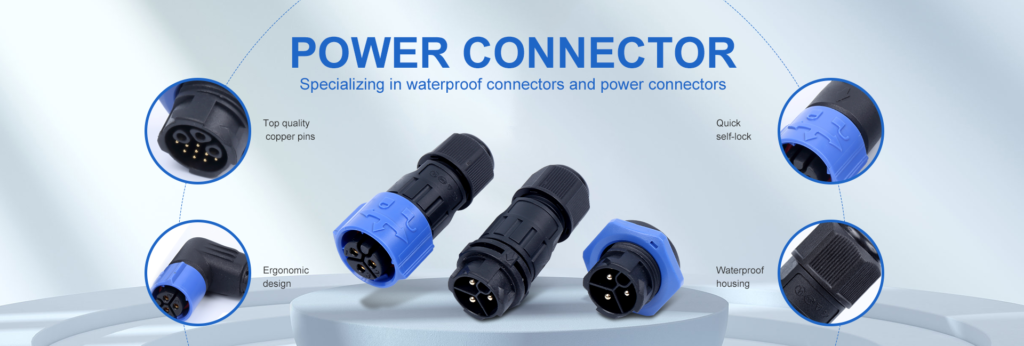
Waterproof connectors are widely used in outdoor lighting, industrial automation, energy storage, electric vehicles, battery swap systems and mobile robots. However, even an IP67 or IP68 connector can fail if it is incorrectly selected, assembled or installed.
Understanding the most common causes of waterproof connector failure helps equipment manufacturers reduce maintenance costs, prevent electrical faults and improve long-term system reliability.
1. Selecting the Wrong IP Rating
The IP rating indicates the level of protection against solid particles and water ingress. The first digit represents protection against solids, while the second represents protection against liquids.
IP67 connectors are generally suitable for dust protection and temporary water immersion under defined test conditions. IP68 connectors are intended for more demanding water exposure, but the exact test depth and duration must be confirmed with the manufacturer.
An IP rating applies only to a specified connector configuration. A connector may achieve its rated protection only when it is fully mated, correctly locked, installed with the specified cable and fitted with the correct sealing components.
2. Incomplete Connector Locking
One of the most common waterproof connector failures is incomplete mating. If a threaded connector is not fully tightened, or a self-locking connector is not completely engaged, the sealing ring may not be compressed correctly. Small gaps can allow moisture, dust and contaminants to enter.
- Follow the recommended assembly procedure
- Confirm that the locking mechanism is fully engaged
- Avoid cross-threading during installation
- Inspect every connection before equipment leaves the factory
3. Damaged or Incorrect Sealing Rings
A missing, twisted, contaminated or damaged sealing ring can cause the entire connection to lose its protection. Seal failure may result from incorrect installation, repeated mating cycles, excessive temperature, chemical exposure or incompatible materials.
Before installation, inspect the seal for deformation, cuts and contamination. Its material should also be compatible with the operating temperature, oil, cleaning chemicals and outdoor environment.
4. Incorrect Cable Diameter
The cable gland and rear seal must match the actual cable outside diameter. If the cable is too small, the gland may not create enough compression. If it is too large, the seal or cable jacket may be damaged during assembly.
When requesting a waterproof connector or custom waterproof cable assembly, provide the cable outside diameter, wire gauge, conductor count, jacket material, required length and bending requirements.
5. Poor Cable Strain Relief
Pulling, bending and vibration can transfer mechanical force directly to the terminals and sealing area. Over time, this may loosen the connection, damage the conductor or create an opening for water ingress.
Reliable strain relief is especially important for AGVs, mobile robots, electric motorcycles, outdoor LED lighting, industrial sensors and battery charging equipment. Cable routing should avoid sharp bends near the connector, and continuously moving equipment should use flexible cable designed for the required bending cycles.
6. Corrosion and Environmental Contamination
Humidity, salt spray, fertilizer residue, industrial chemicals and temperature changes can affect connector contacts and housing materials. Corrosion increases contact resistance and may cause unstable signals, voltage drop or overheating.
Depending on the application, consider corrosion-resistant contact plating, UV-resistant housing, flame-retardant PA66, suitable cable jackets and protective caps for unmated connectors. An open connector is usually not waterproof unless a correctly rated sealing cap is installed.
7. Electrical Overload and Overheating
A connector may be waterproof but still fail electrically if the current, voltage or wire size is incorrectly specified. Excessive current can increase contact temperature, damage insulation and deform the housing. Poor crimping or loose contacts can create additional resistance and localized overheating.
Before selecting a connector, confirm the rated and peak current, voltage, ambient temperature, power contact size, wire gauge, contact material, temperature-rise limit and required certifications. High-current battery and energy storage applications should be evaluated according to the complete operating condition, not only the connector’s headline rating.
How to Improve Waterproof Connector Reliability
A reliable connection begins with complete application information. Before ordering, provide:
- Operating voltage and current
- Number of power and signal contacts
- Required IP rating
- Cable size and outside diameter
- Operating temperature
- Installation and panel-mounting method
- Mating frequency
- Vibration and movement conditions
- Chemical or UV exposure
- Target certifications and annual quantity
Testing should be completed on the final connector and cable configuration whenever possible. Recommended validation may include waterproof, electrical, temperature-rise, tensile, salt-spray and mating-cycle testing.
Choose the Right Waterproof Connector Solution
CONNIXTECH supplies M12 M16 M20 M23 and M25 waterproof circular connectors, high-current battery connectors and custom cable assemblies for industrial applications.
Our OEM and ODM capabilities include custom pin configurations, cable lengths, wire gauges, connector structures, overmolding, panel mounting, logo printing and packaging. Products are inspected through controlled electrical, waterproof and mechanical testing processes.
Whether your project involves outdoor LED lighting, industrial automation, energy storage, battery swap equipment, electric mobility or robotics, selecting the correct configuration can significantly reduce field failures.
Contact CONNIXTECH with your current, voltage, pin count, cable specification, application and estimated quantity. Our technical team will recommend a practical waterproof connector or custom cable assembly solution.
Frequently Asked Questions
Can an IP67 connector remain underwater permanently?
IP67 generally refers to temporary immersion under defined test conditions. It should not automatically be treated as suitable for permanent underwater use. Confirm the required depth, duration and final assembly test conditions with the manufacturer.
Is an IP68 connector always better than an IP67 connector?
Not necessarily. The correct choice depends on the environment, installation method, budget and testing requirements. A properly installed IP67 connector may be sufficient for many outdoor and industrial applications.
Is an unmated waterproof connector still waterproof?
Usually not. Many waterproof ratings apply only when the plug and socket are fully mated. Unused interfaces may require a compatible waterproof protective cap.
What information is needed for a custom waterproof cable assembly?
Provide the voltage, current, pin count, cable length, wire gauge, cable outside diameter, connector type, IP rating, operating temperature, application and estimated order quantity.